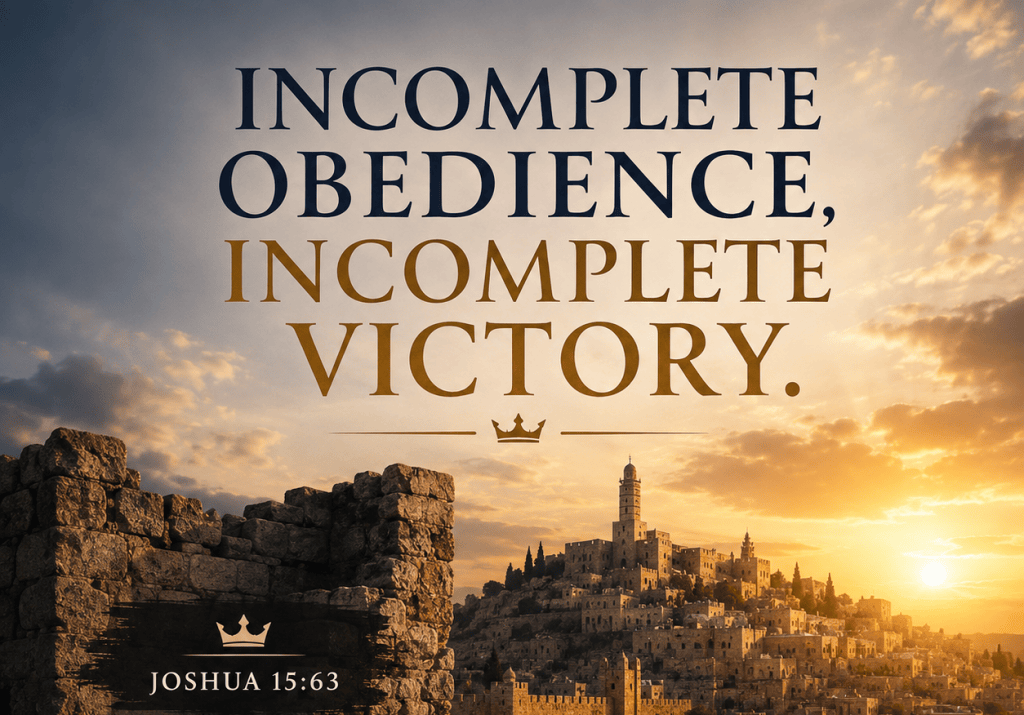
Scripture — NKJV
Joshua 15:63
“As for the Jebusites, the inhabitants of Jerusalem, the children of Judah could not drive them out; but the Jebusites dwell with the children of Judah at Jerusalem to this day.” — Joshua 15:63
What Was Happening in the Text?
Judah had received Jerusalem within its allotted inheritance, yet the chapter closes with an uncomfortable reality: the Jebusites remained. This was not because they were more powerful than God. God had specifically promised to drive out the Jebusites before Israel (Exodus 23:23). Judah even attacked and captured Jerusalem (Judges 1:8), yet Scripture later tells us that the Jebusites were not completely expelled and continued dwelling there (Judges 1:21). There had been victory, but the victory was incomplete.
This became part of a larger pattern in Israel. Other tribes also failed to completely drive out the inhabitants of their territories, until God confronted them: “You have not obeyed My voice. Why have you done this?” (Judges 2:2). What God commanded them to remove, they gradually learned to live beside. Incomplete obedience eventually produced incomplete possession.
Yet the story did not end there. Generations later, David came against Jerusalem, and the Jebusites were so secure in their stronghold that they mocked him, believing he could not enter. Then Scripture declares: “Nevertheless David took the stronghold of Zion” (2 Samuel 5:7). What had remained unconquered for generations finally fell. David then lived there and called it the City of David. The enemy’s stronghold became the king’s dwelling place.
Reflection 2: What Does This Mean for Me?
There are areas where we can experience genuine progress while still leaving pockets of resistance untouched. We can obey God in many things while quietly learning to coexist with something He has been asking us to confront: a compromise, fear, unhealthy attachment, bitterness, distraction, habit, or pattern. Sometimes what remains is not evidence that God cannot give us victory; it may reveal an area where our obedience has remained incomplete.
The Jebusites also remind us that longevity does not equal legitimacy. Something can remain so long that we begin believing it belongs there. We may say, “This is just how I am,” “My family has always struggled with this,” or “I have tried before and nothing changed.” But David confronted what previous generations had learned to tolerate. What has been present for generations does not automatically have permission to remain for another one.
Perhaps there is still some “Jebusite territory” within what God has called you to possess. Do not allow yesterday’s incomplete victory to become today’s permanent expectation. The same place that once represented resistance became David’s dwelling place. God can transform the territory of your greatest struggle into the testimony of His grace. What one generation tolerates can become the next generation’s stronghold, but what one generation confronts in obedience can become the next generation’s testimony.
Reflection Questions
- What have I become comfortable living with that God may be asking me to confront?
- Where have I settled for partial obedience because complete obedience feels difficult?
- Is there a longstanding or generational pattern that I have mistakenly accepted as permanent?
Prayer
Father, reveal every area where I have settled for incomplete obedience or learned to tolerate what You are calling me to confront. Give me grace and courage to obey You fully. May longstanding strongholds fall, cycles end, and places of resistance become testimonies of Your faithfulness. In Jesus’ name, Amen.
****************
Thank you for spending this time with me in God’s Word. ❤️ I’d love to hear what spoke to you, so leave a comment below. And if this encouraged you, share it with someone who may need it too.
Let’s keep seeking Him together.
With love,
Nessa


Leave a comment